
No products in the cart.
Palm Weevil Early Detection: Catching It Before the Crown Dies
Palm weevil early detection, in short: by the time a palm shows crown symptoms, the larvae have usually already destroyed the growing heart — and the tree is unsavable. There are three ways to catch an infestation earlier: pheromone traps (cheap area-wide warning that weevils are flying nearby), trained visual inspection (free, but usually catches it late), and in-trunk seismic sensors (per-tree listening devices that hear larvae feeding weeks before anything is visible — the only method shown in peer-reviewed work to catch infestations early enough to treat and to verify the treatment worked). I grow dates in the Coachella Valley; here is the honest comparison.
Why “wait and see” kills palms
The South American palm weevil lays its eggs at the top of the palm, and the larvae feed inside the crown — hidden in exactly the tissue the tree needs to grow. The visible signs (a tilted spear, flattened crown, oozing, frass) typically appear only after the apical meristem — the palm’s single growing point — is badly damaged. Palms have no backup growing point: once the heart is gone, the tree is gone. That’s why more than 20,000 palms around San Diego have been lost, and why SAPW’s arrival in the Coachella Valley has every grower here paying attention. Early detection isn’t a nice-to-have; it’s the whole game.
We grow these. Golden Zahidi Dates — Nutty, Less Sweet, Never Sticky | California Farm-Direct from our family farm in Sky Valley, California — from $15/lb, shipping included. See them →
Method 1: Pheromone traps — the area alarm
Bucket traps baited with aggregation pheromone tell you adult weevils are flying in your area. They’re cheap (roughly $50 a trap plus lures), they’re how UC Riverside and the state run their early-warning network, and every grower near an infestation zone should run a couple. Two honest limitations: a trap tells you weevils are around, not which tree they’ve entered — and because the pheromone attracts weevils, traps must be placed well away from the palms you’re protecting (UC guidance says hundreds of yards). Traps are the smoke detector for the neighborhood, not for the tree.
Method 2: Visual inspection — necessary, usually late
On our farm we check crowns routinely: a spear leaf that tilts or pulls out easily, chewed frond bases, wet oozing spots, sawdust-like frass, a crown that looks subtly asymmetric. Inspection costs nothing and every palm owner should learn the signs. But the uncomfortable truth from everyone who has fought this pest: visual symptoms are mostly late-stage symptoms. Inspection finds trees to remove more often than trees to save.
Method 3: In-trunk seismic sensors — listening for larvae
The newest tool is a small seismic sensor screwed a few inches into the trunk that listens for the vibration signature of larvae feeding inside — continuously, tree by tree, reporting to the cloud over a cellular gateway. This is the only approach with peer-reviewed field evidence of catching infestations early enough to treat:
- In a 2023 study in Pest Management Science (Mendel et al., Israel’s Volcani Institute), sensors cleanly separated infested palms from healthy ones: healthy trees produced baseline activity readings around 10, infested trees 26 and up.
- After successful treatment, readings fell back to healthy-tree levels — meaning the sensors could verify the treatment actually worked without cutting the tree open, something no trap or visual check can do.
- Where treatment failed, renewed larval activity showed up on the sensors within weeks — those trees got a second treatment instead of a surprise collapse.
- The field accuracy figure cited for the commercial system (IoTree, by Agrint) is about 95%, from the manufacturer’s larger deployments; the published study covered 58 palms. (full paper, PDF)
The trade-off is cost and commitment: sensors are a per-tree investment with an annual monitoring service, which makes sense exactly where the trees are worth it — commercial date gardens, and the Canary Island date palms that anchor resorts, golf courses and estates, where removing one dead palm costs more than monitoring a whole row.
What we do on our own farm
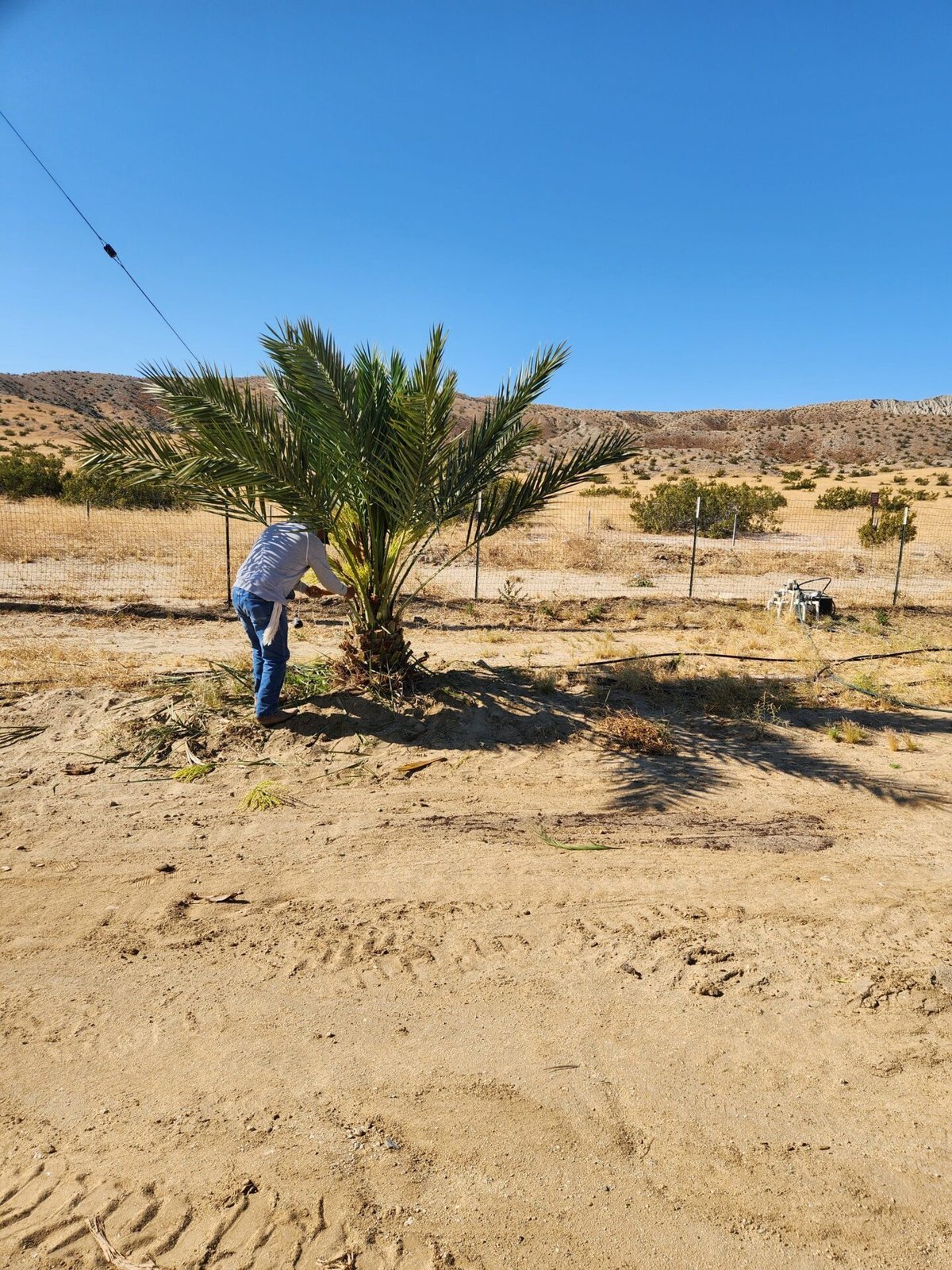
Our grove is isolated and unsprayed, and we intend to keep it that way — which makes monitoring, not blanket spraying, our line of defense. We watch the UC Riverside trap reports, inspect crowns on a schedule, keep our pruning inside the low-flight winter window, and we’re evaluating per-tree sensors for the orchard as SAPW moves closer. For the research side, UC Riverside’s Center for Invasive Species Research and UCANR’s SAPW pages are the references we trust.
Early detection questions
Can a palm with weevil damage be saved?
Sometimes — if it’s caught before the growing point is destroyed. That window is exactly what early detection buys. Once the crown collapses, removal is the only option.
Do pheromone traps protect my palms?
They warn you weevils are in the area and help suppress adults, but they don’t monitor individual trees — and placed too close, they can draw weevils toward the palms you’re protecting.
How early can sensors detect an infestation?
In published and field testing, in-trunk seismic sensors detect larval feeding weeks before visual symptoms — while the tree is still treatable.
Worried about specific palms? We offer date palm consulting from our working farm — honest assessment, no spray-company agenda. And the fruit that keeps the lights on: fresh jumbo Medjool and golden Zahidi, farm-direct.
More from the farm: SAPW and date palms: what to know · the date farmer · growing dates in Sky Valley
From our farm to your door
We grow every date we sell on our family farm in Sky Valley, California. Shipping is included in the price to the lower 48.
- Jumbo Medjool Dates — large, soft, caramel-sweet, from $19
- Golden Zahidi Dates — firm, nutty — the baking date, from $15
- Barhi Dates — butterscotch, creamy, seasonal, between harvests