
No products in the cart.
Frost and Cold Damage on Date Palms: What to Expect and What to Do
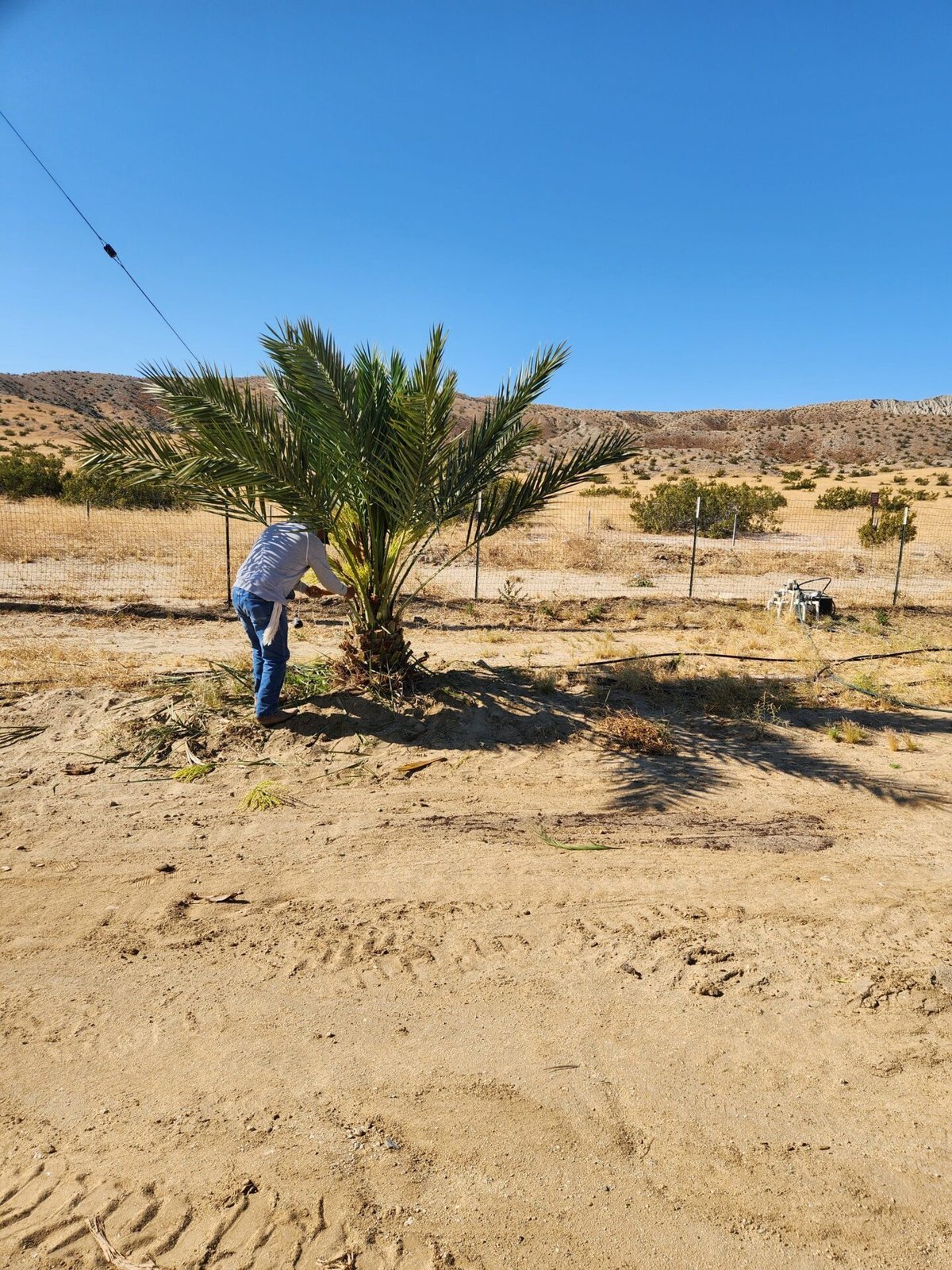
Date palms are desert trees, and deserts freeze. People are surprised by both halves of that sentence. The good news: Phoenix dactylifera is among the cold-hardiest of the big fruit palms — a mature, healthy date palm shrugs off the typical desert frost. The catch: young palms, fresh offshoots and newly moved trees are a different story, and even on big palms a hard freeze leaves marks that show up months later. Here’s the honest winter picture from a farm in Sky Valley, where cold air pools on the valley floor on clear January nights.
What cold actually does to a date palm
- A light frost — the common desert kind, a few hours around freezing — a mature palm barely notices. This is date country for a reason.
- A hard freeze — well below freezing for hours — burns foliage. Fronds bronze, then brown, oldest first. It looks alarming and mostly isn’t: fronds are expendable.
- The bud is the tree. A palm has one growing point, buried deep in the crown, insulated by the mass of the trunk and the tied column of fronds above it. Mature date palms survive serious freezes because that bud stays protected. The real risk after a bad freeze is rot getting into a cold-damaged crown — which is why the damage sometimes shows as a struggling spear months later, in spring.
- Timing is merciful here. The crop comes off in fall, so by the time real cold arrives, the year’s fruit is already in the cold room. Winter cold costs fronds, not dates.
Who actually needs protecting
- First- and second-year offshoots. Small mass, shallow new roots, bud close to the ground — these are the palms a freeze kills. Wrap the column of tied fronds with burlap or frost cloth on forecast freeze nights, mulch the basin, and water the day before a freeze (moist soil holds and releases heat all night; dry sand doesn’t). The full first-two-years routine is in our offshoot care guide.
- Anything transplanted this year. A palm still rebuilding roots after a move has no spare resources — treat it like an offshoot for its first winter. (Another reason moves happen in the warm months.)
- Cold pockets. Cold air drains downhill and settles — the low corner of a property can run several degrees colder than the house. If one palm always burns and its twin doesn’t, that’s why.
After a freeze: the one rule
Don’t prune burned fronds until spring. Brown fronds still insulate the crown against the next freeze, and cutting into a cold-stressed palm invites rot — and in Southern California, every fresh cut on a stressed palm is also an invitation we no longer extend lightly (see why pruning timing matters for weevils). Wait until the palm is pushing new growth and the freeze season is over, then clean it up. If the spear itself pulls loose or smells sour after a bad freeze, that’s a crown infection — a job for a professional, fast; our consulting page is a sane first call.
We grow these. Golden Zahidi Dates — Nutty, Less Sweet, Never Sticky | California Farm-Direct from our family farm in Sky Valley, California — from $15/lb, shipping included. See them →
Meanwhile, winter is prime date-eating season — the harvest is in and the fruit is at its best. Jumbo Medjool and golden Zahidi ship farm-direct all winter, shipping included to the lower 48.
From our farm to your door
We grow every date we sell on our family farm in Sky Valley, California. Shipping is included in the price to the lower 48.
- Jumbo Medjool Dates — large, soft, caramel-sweet, from $19
- Golden Zahidi Dates — firm, nutty — the baking date, from $15
- Barhi Dates — butterscotch, creamy, seasonal, between harvests