
No products in the cart.

Why Medjool Dates Get So Big: Thinning the Bunches
A jumbo Medjool is not a lucky date. It’s a decision a farmer made in spring with a pair of clippers. Left alone, a date palm sets far more fruit than it can size up — you’d harvest thousands of small, mediocre dates. Thinning is how growers trade quantity for the big, soft fruit Medjool is famous for, and it’s one of the most labor-intensive steps in the whole year. Here’s what actually happens up the ladder.
Three cuts, one goal
- Bunch thinning — how many bunches the palm keeps. A mature palm will happily carry more bunches than it can feed well. Growers cut whole bunches down to a number the palm can actually size up — the stronger and older the palm, the more it keeps. Every bunch removed sends its share of sugar to the ones that stay.
- Strand thinning — opening up each bunch. Inside a bunch, dates grow on dozens of strands. Removing a share of the strands — especially from the crowded center — gives the remaining fruit room, light and airflow. On Medjool this is the famous move: the center of each bunch gets cleaned out so air moves through, which also fights rot when late-summer humidity spikes.
- Tip-back — shortening the strands that stay. Cutting the end third or so off each remaining strand removes the smallest, latest fruit, and the dates left behind take the difference.
What thinning buys
- Size. The palm makes roughly the same sugar either way; thinning decides whether it goes into thousands of small dates or into the jumbo fruit that runs 22–28 to the pound.
- Moisture and texture. Fewer dates ripen more evenly and hold the soft, fudgy texture people buy Medjool for.
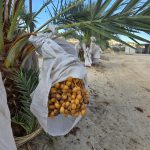
- Airflow. An opened bunch dries after rare summer rain instead of souring — thinning and bagging work as a pair.
- Next year’s crop. A palm allowed to over-crop exhausts itself and rewards you with a light year. Thinning evens the swing.
Why you feel it in the price
All of this is hand work, on ladders, in late-spring heat, touching every bunch on every palm — and it removes a large share of the crop on purpose. It’s a big part of why real Medjools cost what they cost: the grower deliberately grew fewer dates so each one would be worth eating. When you see a truly jumbo Medjool, you’re looking at the survivor of three rounds of cuts — then hand-picking over several passes on top of it.
We grow these. Golden Zahidi Dates — Nutty, Less Sweet, Never Sticky | California Farm-Direct from our family farm in Sky Valley, California — from $15/lb, shipping included. See them →
Taste what thinning does: our jumbo Medjool comes off exactly these bunches, and golden Zahidi is the firmer, less-sweet counterpart — both farm-direct, shipping included to the lower 48.
From our farm to your door
We grow every date we sell on our family farm in Sky Valley, California. Shipping is included in the price to the lower 48.
- Jumbo Medjool Dates — large, soft, caramel-sweet, from $19
- Golden Zahidi Dates — firm, nutty — the baking date, from $15
- Barhi Dates — butterscotch, creamy, seasonal, between harvests