No products in the cart.
How to Tell If You’re Actually Buying From a Date Farm
Search “farm fresh Medjool dates” and every result says farm. Family farm, our orchard, grown with care, straight from the grove. Some of those are literally true. Some are a photo of somebody else’s palm trees on a company that buys by the pallet and re-boxes it.
Both are legal, and buying from a packer is not a scandal — plenty of them handle good fruit. But you are probably paying a farm price, so it is fair to want to know which you are getting.
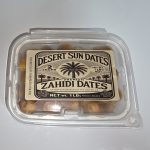
We grow these. Golden Zahidi Baking Dates — Shipping Included | California Farm-Direct from our family farm in Sky Valley, California — from $19/lb, shipping included. See them →
I grow dates in Sky Valley, California, so I am hardly neutral. Here is the checklist anyway. It works on us too, and I will answer every question on it as we go.
1. Can you find the actual location?
Not “the Coachella Valley.” A road. A town. Somewhere you could point at on a map and drive to.
A grower has a physical place because the trees cannot be anywhere else. If the only address you can find is a suite number in an office park, that does not prove anything on its own — plenty of farms keep a business office in a city. But you should be able to find the ground somewhere.
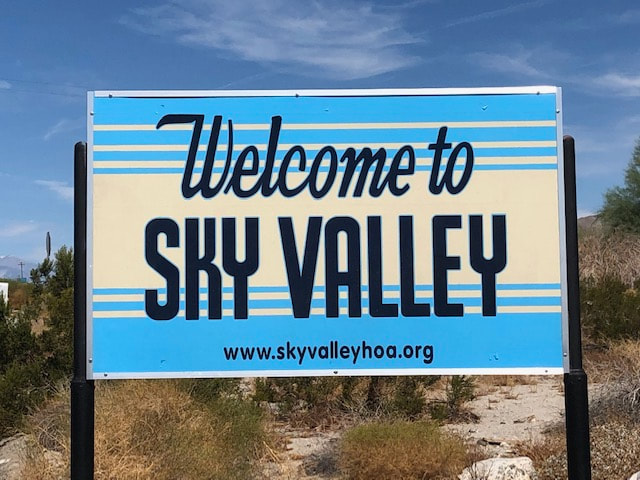
Ours: Sky Valley, Sky Valley, California, in the desert between Palm Springs and Indio. Call (760) 501-1845 and come see it.
2. Do they go out of stock?
This is the one nobody expects, and it is the most reliable signal on the list.
Dates are harvested once a year, late summer into autumn. A farm sells what its own trees made, so a farm runs out. Varieties disappear. Seasons end. A seller who has every variety in every size available all year round is buying from somewhere, because no single orchard produces like that.
Ours: our Barhi are gone right now. They come in August and September, they are eaten fresh rather than dried, and when they are finished they are finished until next year. I would rather tell you that than pretend.
3. Are the photos theirs?
Stock photography of date palms is cheap and everywhere. Real farm photos look worse and prove more: a hand in frame, dirt, a ladder, the paper bags tied over fruit clusters in August, a shed that needs sweeping.
Reverse image search is free. Drop their hero photo into Google Images and see whether it appears on forty other sites.
Ours: this is my hand, on my ladder, pollinating my palms in April. It is not a good photograph. It is a true one.
4. Do they talk about the work, or only the product?
Ask a grower a farming question and you get more answer than you wanted. When did you pollinate. How many offshoots did you plant. What did the heat do this year. Did you bag before the birds got in.
You can test this in one email. Ask any seller: “When did you harvest the fruit I’d be getting?” A grower answers with a month and probably a complaint about the weather. Anyone else answers vaguely, because they do not know — they bought it.
5. Do they publish the weight?
Not a farm test exactly, but a straight-dealing test, and it costs you real money.
If a listing gives you a price and a box but no weight, you cannot work out the price per pound — which is the only number that lets you compare two sellers. A $35 box could be $11 a pound or $18 a pound and you would never know.
Ours: every size shows the weight and the per-pound price. $19 for 1 lb is $19.00/lb. $118 for 12 lb is $9.83/lb. All six sizes are listed here.
6. Where does shipping land?
A low sticker price with freight added at the last step can end up costing more than a higher price with shipping inside it. Put both in a cart and go as far as the shipping line before you judge.
Ours: included in the price to the lower 48, nothing added at checkout. Alaska and Hawaii we charge for, because a box there costs about what the fruit inside it is worth, and I am not going to pretend otherwise.
7. Do the claims stop where the certificates stop?
“Organic” is a certification with an auditor behind it. “Sugar-free” on a fruit that is two-thirds sugar is not a claim, it is a hope. Watch what a seller does at the edge of what they can prove.
Ours: we grow without pesticides but we are not certified organic, and we will not imply we are. We are not kosher certified. Our dates are not sugar-free — a Medjool is roughly 65–75% sugar, all of it the fruit’s own, with nothing added. And no date palm anywhere in commercial production is genetically modified, so “non-GMO dates” describes every date on earth rather than a difference between brands.
The short version
Ask where it is. Ask when it was picked. See whether they ever run out. Check whether the weight is printed. Notice where the claims stop.
You do not have to buy from us. But run whoever you do buy from through those seven, because the seller who passes all of them is the one who has nothing to hide behind — and if you are ever driving through the valley, come and look at our trees.
Jumbo Medjool → · Zahidi → · In stock today →
Written by Jason Shopshear, who grows dates in Sky Valley, California, and therefore has an obvious interest in how you answer these questions. No specific company is described anywhere in this article.
From our farm to your door
We grow every date we sell on our family farm in Sky Valley, California. Shipping is included in the price to the lower 48.
- Jumbo Medjool Dates — large, soft, caramel-sweet, from $19
- Golden Zahidi Dates — firm, nutty — the baking date, from $19
- Barhi Dates — butterscotch, creamy, seasonal, between harvests