
No products in the cart.
How Dates Are Pollinated by Hand (On Our Farm, Every Spring)
Here is something most people never learn about the dates in their pantry: almost every single one exists because a person climbed a palm tree and pollinated it by hand. Not bees. Not butterflies. A farmer, a ladder or a climbing rig, and a few weeks each spring when the whole harvest is decided.
On our farm in the Coachella Valley, pollination season is the quiet, make-or-break stretch of the year — months before anyone tastes a date. Here is what actually happens, and why it has been done this way for thousands of years.
We grow these. Fresh Jumbo Medjool Dates — Shipping Included | California Farm-Direct from our family farm in Sky Valley, California — from $19/lb, shipping included. See them →
Date Palms Come in Male and Female — and Only Females Make Fruit
Date palms are dioecious: every tree is either male or female. Female palms produce the flowers that become dates. Male palms produce pollen — and nothing you can eat. Left entirely to the wind, some pollen finds some flowers, but nowhere near enough for a real crop. Wild, wind-pollinated palms set sparse, small fruit.
That is why date farming has never really been a “plant it and wait” business. A commercial orchard keeps only a handful of male palms — roughly one male can supply pollen for dozens of female trees — and the farmer becomes the pollinator, moving pollen from the few males to the many females at exactly the right moment.
A Few Weeks in Spring Decide the Whole Year
In late winter and early spring, the palms push out sheaths called spathes. When a spathe cracks open, the flowers inside are ready — and the clock starts. Each female bloom is at its most receptive for only a short window. Miss it, and that strand simply will not set fruit. There is no do-over until next year.
So for those weeks, the work is constant: watching every tree, harvesting pollen from the male palms as their spathes open, and getting that pollen onto every freshly opened female bloom in time. On a mature palm, that means going up the trunk — the fruit-bearing crown of a producing Medjool palm can be several stories off the ground.
How the Pollen Gets There
The core of the job has not changed since date culture began in Mesopotamia: collect the male flower strands, let the pollen dry, then transfer it into the female flower clusters by hand. Some growers dust pollen-laden male strands directly into the female bloom and tie them in place; others apply collected pollen with a puffer or duster. Either way, a human being visits every producing palm, every season — you can watch exactly how it looks on our trees in the video above.
Ancient Assyrian carvings show winged figures doing precisely this with date flowers, four thousand years ago. The ladders have improved. The job description has not.
Why We Do Not Just Let Nature Handle It
Hand pollination is not stubborn tradition — it is the difference between an orchard and a curiosity. Pollinating by hand means every fruiting strand actually gets pollen, which means full clusters of large fruit instead of patchy set. It also lets the farmer control how much fruit each palm carries: paired with thinning, it is why a farmed Medjool is a plump, caramel-dense giant instead of the small, seedy fruit a wild palm makes. Quality in dates is decided in April, not at harvest.
From Pollination to Your Pantry
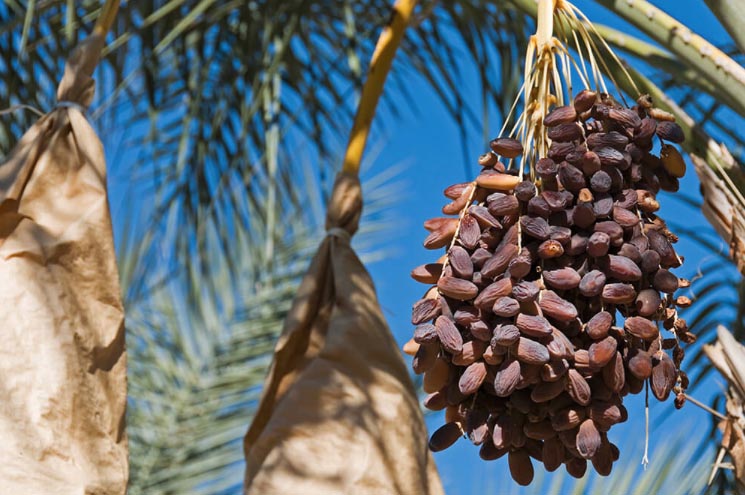
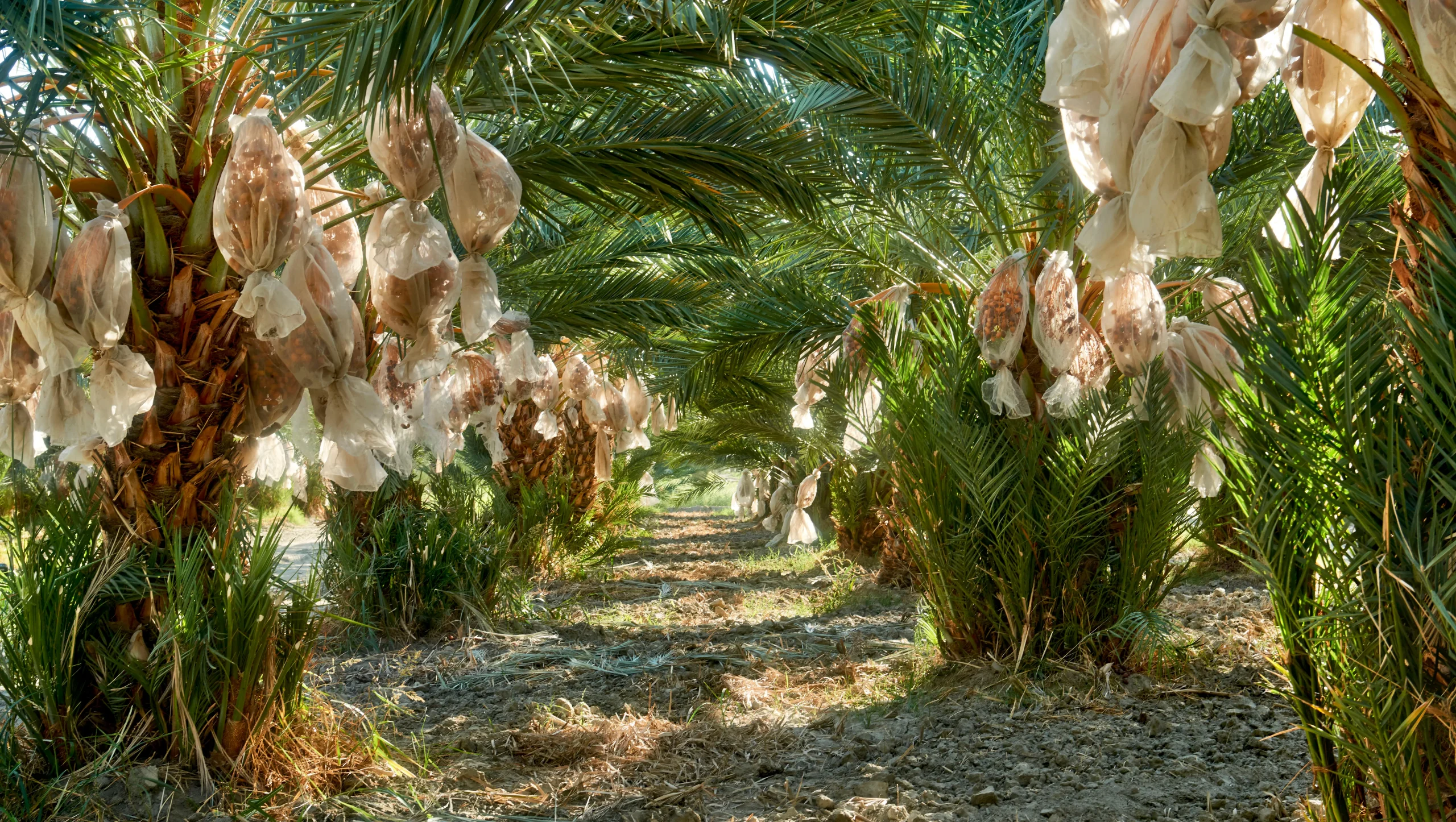
Once pollinated, the dates spend the desert summer swelling and sweetening in the heat — this valley’s brutal summers are exactly what Medjools need. But the hands-on work is not over: as the clusters develop, we bag each one on the tree, shielding the ripening fruit from birds, insects, wind, and weather while it finishes maturing. Here is that step, on our palms:
By late September into October, the bagged clusters are ready to pick — again by hand, tree by tree. From a spring morning up a palm to the box on your doorstep, every date is touched by human hands not twice but many times: pollinated, thinned, bagged, picked, and packed.
When you taste a Medjool from our farm, you are tasting that entire year of attention — which is the honest reason farm-direct dates taste different from a supermarket bag that is a season old.
Quick Answers
Are dates pollinated by bees? No. Date palm flowers offer little to attract bees; dates are naturally wind-pollinated, and commercially they are pollinated by hand for a full crop.
Do you need a male date palm to get fruit? Yes — female palms only set proper fruit with pollen from a male palm (or collected pollen applied by hand). One male can serve dozens of females.
When are date palms pollinated? Late winter through spring, as each flower sheath opens. Each bloom is receptive for only a short window.
Can a backyard date palm produce dates? Only if it is female, gets pollen at bloom time, and enjoys long, very hot summers — which is why the Coachella Valley grows most American dates.
From our farm to your door
We grow every date we sell on our family farm in Sky Valley, California. Shipping is included in the price to the lower 48.
- Jumbo Medjool Dates — large, soft, caramel-sweet, from $19
- Golden Zahidi Dates — firm, nutty — the baking date, from $15
- Barhi Dates — butterscotch, creamy, seasonal, between harvests