
No products in the cart.
How to Plant a Date Palm Offshoot: Depth, Basin and the First Year
The first year decides whether an offshoot becomes a fruiting palm. Most failures we see come down to two things: planting at the wrong depth, and watering that is either too stingy or so heavy the base sits in mud. Here is how we plant offshoots in our Sky Valley rows.
Pick the spot first
- Full sun and real heat. Date palms fruit best where summers are long and hot. Shade from buildings or bigger trees slows everything down.
- Drainage. Date palms drink a lot but hate standing water at the base. Sandy desert soil suits them; heavy clay needs care with watering.
- Room to grow. Commercial groves commonly space palms roughly 25 to 30 feet apart. A palm squeezed against a wall or another tree is hard to pollinate, harvest and prune later.
Planting depth: the one rule that matters most
Set the offshoot so the widest part of its base sits at or just below the soil surface, deep enough that it stands firmly, but never so deep that soil covers the heart, the growing point in the center of the crown. Soil or standing water in the heart can rot the palm. Bigger offshoots are planted somewhat deeper to keep them upright.
We grow these. Golden Zahidi Dates — Nutty, Less Sweet, Never Sticky | California Farm-Direct from our family farm in Sky Valley, California — from $15/lb, shipping included. See them →
- Dig a hole wider than the root ball so new roots meet loose soil.
- Set the offshoot upright at the right depth and check it from two sides.
- Backfill with the native soil, firming it as you go to remove air pockets.
- Build a raised ring of soil around it to form a watering basin a few feet across.
- Flood the basin slowly to settle the soil around the roots.
Protect it while it roots
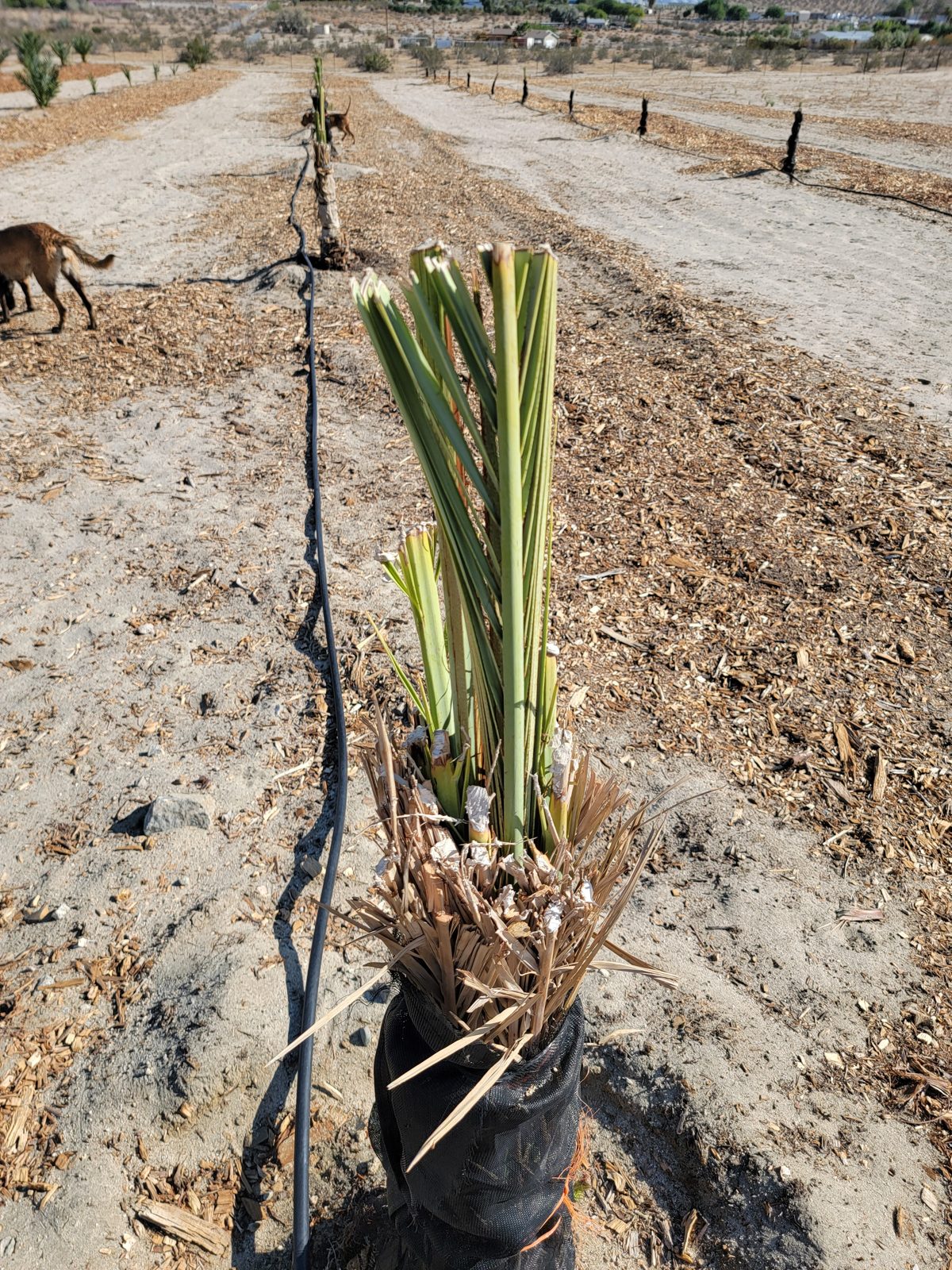
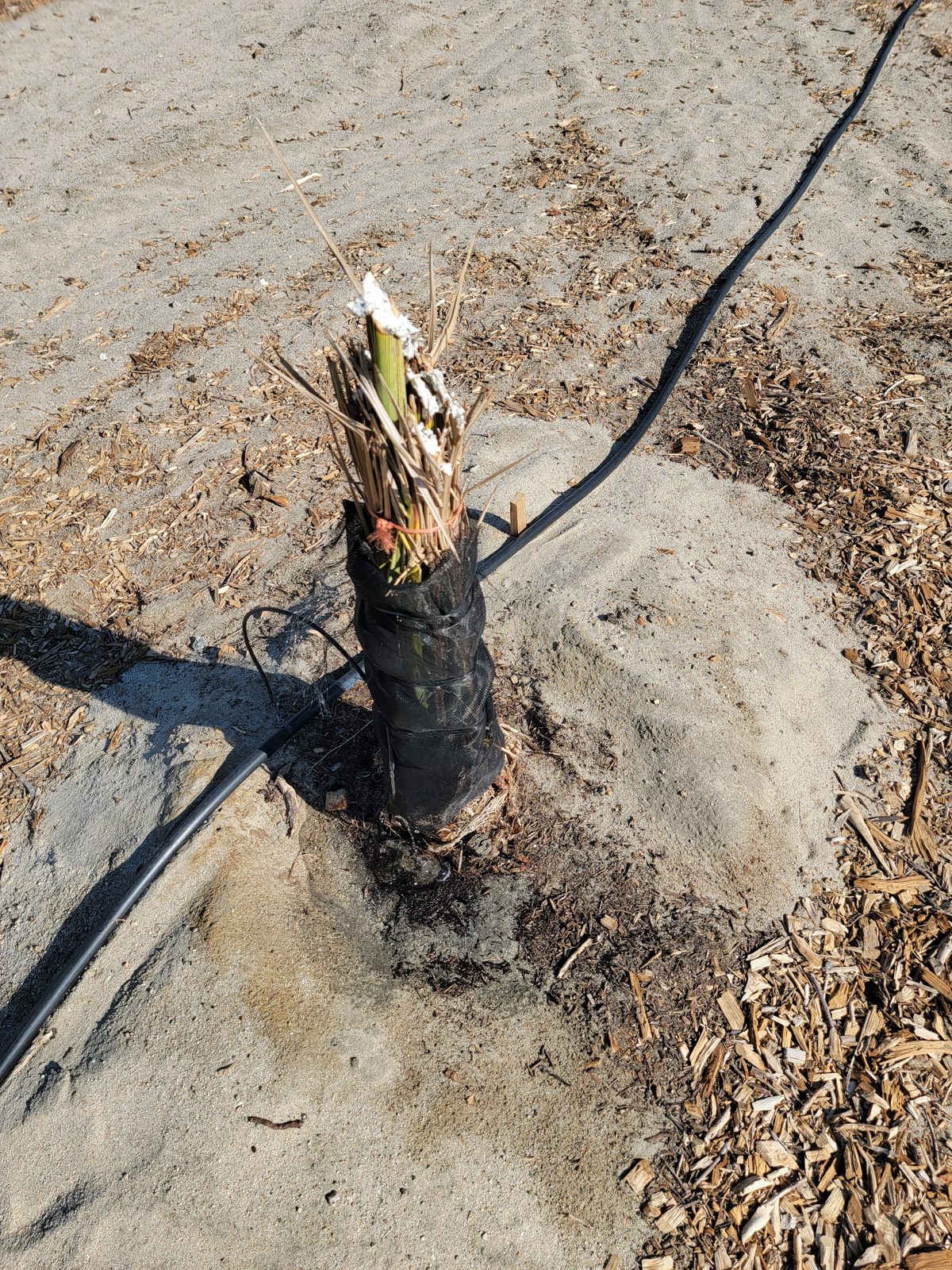
A freshly cut offshoot has lost most of its roots and has to grow new ones before it can keep up with the desert sun. Keep its trimmed leaves tied up for the first months, and in hot weather wrap the tied bundle loosely in burlap or give it shade cloth. That reduces water loss while the roots catch up. Container-grown “rooted” offshoots establish much more easily than fresh-cut ones because their roots are already intact.
Watering in the first year
Keep the root zone consistently moist, not waterlogged. Frequent, deep fills of the basin in the first weeks; then gradually stretch the interval as new growth appears and the weather allows. In summer heat a young offshoot may need water far more often than you expect. We run drip into the basin and check moisture by hand. For the bigger picture on how much a date palm drinks, see How Much Water It Actually Takes to Grow a Date Palm.
Hold off on heavy feeding in the first months. A layer of clean compost on the basin surface is plenty. More in Fertilizing Date Palms.
How to tell it’s taking
Expect the outer leaves to brown. That alone isn’t failure. The sign you want is a new spear leaf pushing up from the center. Some offshoots show it within weeks; others take a full season. If the center leaf pulls out easily or the heart smells of rot, the offshoot has failed. Give a healthy-looking one a whole growing season before you judge it.
Quick Answers
Can I plant a date palm offshoot in a pot? For a few years, yes, in a large container. Long term a fruiting date palm needs to be in the ground.
Should I put fertilizer in the planting hole? No. Strong fertilizer near damaged roots does more harm than good. Compost on top is enough at first.
When will it fruit? Usually several years after planting, and only if it is female and gets pollinated. See Why Isn’t My Date Palm Fruiting?
Date Palm Care series, from our orchard in Sky Valley
- How to remove a date palm offshoot
- How to plant a date palm offshoot
- Date palm care calendar, month by month
- Fertilizing date palms with compost
- Pruning and dethorning date palms
- Male vs. female date palm
- Why isn’t my date palm fruiting?
- South American palm weevil and date palms
Every grower guide we publish lives in the Date Palm Growers’ Hub.
Looking for a true-to-variety female offshoot? We sell female Zahidi and limited Medjool offshoots from our orchard: reserve one here. Or taste what these palms grow: Shop Medjool → · Golden Zahidi
From our farm to your door
We grow every date we sell on our family farm in Sky Valley, California. Shipping is included in the price to the lower 48.
- Jumbo Medjool Dates — large, soft, caramel-sweet, from $19
- Golden Zahidi Dates — firm, nutty — the baking date, from $15
- Barhi Dates — butterscotch, creamy, seasonal, between harvests