
No products in the cart.
Offshoots vs. Tissue Culture: How a New Date Palm Actually Gets Started
Buy a date palm today and you’ll hit a fork in the road almost nobody explains clearly: is the tree you’re getting a dug offshoot from a real mother palm, or a lab-grown clone raised from a few cells in a tissue-culture facility? Both produce a “Medjool.” Both can fruit. They are not the same tree, grown the same way, and the difference matters if you’re planting one yourself.
Here’s the honest comparison — our own palms are direct offshoots from an established Coachella Valley grower’s stock, which is exactly why we went and read the lab literature closely before we ever planted anything.
We grow these. Golden Zahidi Dates — Nutty, Less Sweet, Never Sticky | California Farm-Direct from our family farm in Sky Valley, California — from $15/lb, shipping included. See them →
The old way: an offshoot, dug by hand
Date palms don’t come true from seed — a seed from a Medjool date will not grow into a Medjool palm, any more than an apple seed grows the same apple. So for roughly four thousand years, the only way to get a specific variety has been to take a piece of an existing female palm that is already that variety, and grow it into its own tree.
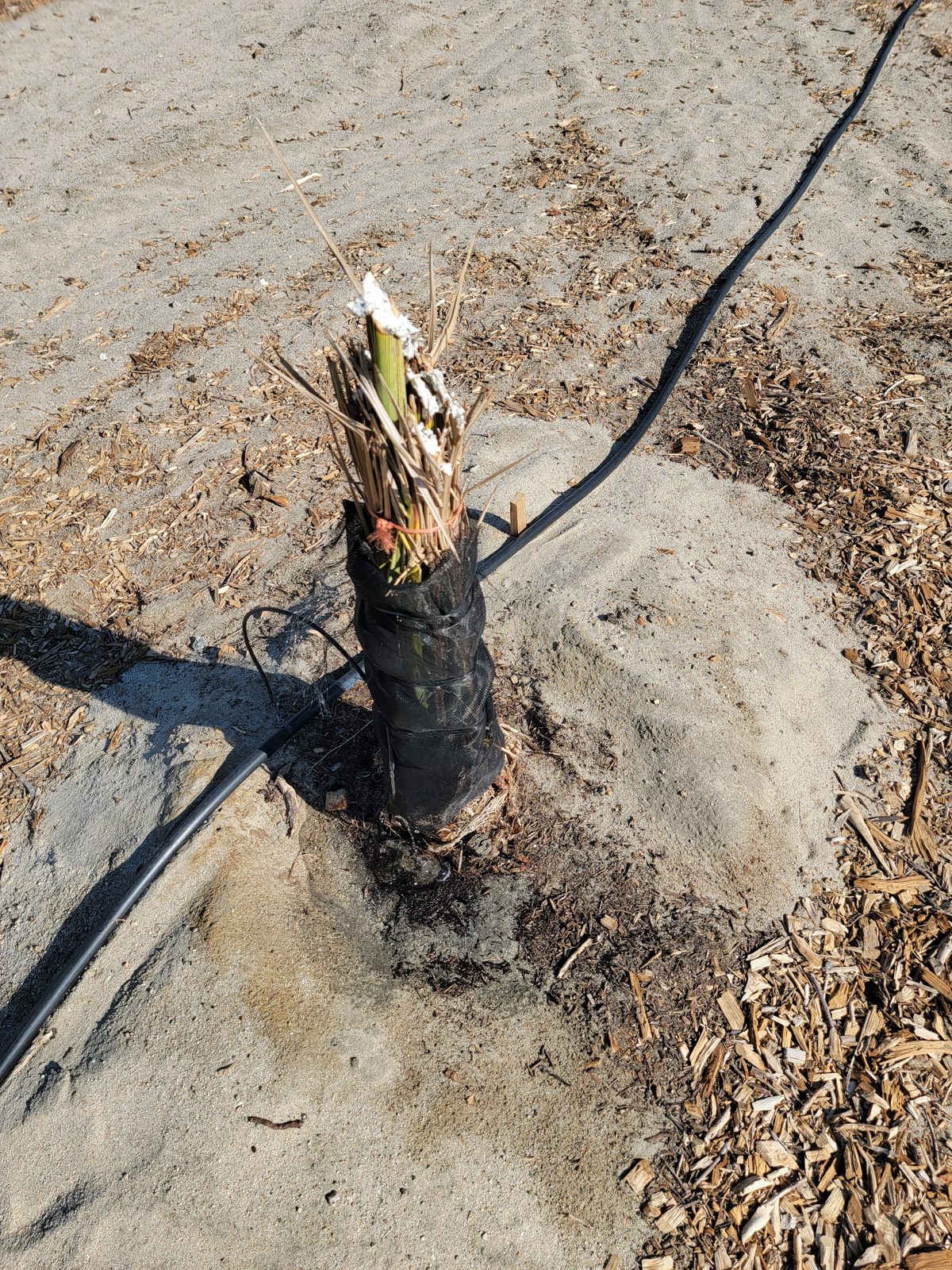
That piece is an offshoot (also called a pup or sucker) — a genetically identical sprout a mature palm throws off near its base. Growers cut it free with most of its young roots attached, trim it down hard, and replant it directly in the field. Studies on the process (Hodel & Pittenger, UC Cooperative Extension, 2003) found that offshoots with more intact roots at the time of removal re-establish faster and more reliably — over two-thirds of a transplanted offshoot’s new root growth comes directly off the roots it already had, not from scratch. Survival in the field still runs a real range, commonly cited between 50% and 90% depending on the grower, the size of the offshoot, and how it’s handled in transit.
An offshoot is slow to come by. A mature palm only produces a handful over its early years, which is a big part of why good offshoots of named varieties have historically run $100–$300 each, and why offshoot theft has been a real problem in California and Arizona date country. But what you plant is, quite literally, a cutting of a specific tree that has already proven it fruits well.
Not every offshoot is an equal bet
The 2003 UC Cooperative Extension study that looked closely at offshoot establishment (Hodel & Pittenger, published in the journal Palms) dug up, photographed, and tracked twelve individual Deglet Noor offshoots from the same commercial grove to see why some take off and others stall. The variation was stark even within that one batch of twelve: some offshoots, cut with a healthy mass of existing roots, pushed out dense new secondary root growth within weeks of replanting. Others, cut with a poorly developed root initiation zone — the band of tissue at the base where new roots actually originate — came up with little to no root growth at all months later, despite being planted, watered, and fertilized identically.
The practical upshot: the single biggest predictor of whether a dug offshoot lives or dies isn’t the grower’s skill after planting — it’s how much root mass that offshoot already had attached when it was cut from the mother palm. Over two-thirds of a transplanted offshoot’s new roots were found to grow directly off roots it already had, not from scratch off bare stem tissue. That’s why a careful offshoot seller or nursery will tell you plainly how many roots an offshoot carried at digging, and why buying one sight-unseen from an unverified source is a real gamble — the tree can look identical above ground and still be a coin flip below it.
The new way: a plant grown from a few cells
Tissue culture (also called micropropagation) sidesteps the scarcity. A lab takes a small piece of living tissue from a proven mother palm, and under sterile conditions coaxes it to multiply into dozens or hundreds of genetically identical plantlets, which are gradually hardened off and grown out into small trees ready for the field. University labs (including UAE University’s Date Palm Development Research Unit) have published detailed field-planting protocols for exactly this kind of plant — smaller, younger, and more uniform than a dug offshoot, typically arriving at nurseries around 35–40 cm tall with just three or four leaves.
The appeal is obvious at scale: one mother palm’s tissue can theoretically produce thousands of true-to-type trees instead of a handful of offshoots, at a lower price per tree, with every plant the same age and size — which matters a great deal to a commercial grower trying to mechanize pollination or harvest later on. It’s a large part of how new, large-acreage date plantings have expanded as fast as they have in places like the Coachella Valley, the Central Valley, and the Middle East over the past few decades.
What the trade-off actually is
Tissue culture isn’t free of questions. The literature on it is extensive — and the one that comes up again and again is somaclonal variation: the small but real chance that a plantlet grown this way doesn’t come out perfectly true to the mother palm, because something shifted during the lab process. Growers and researchers have developed genetic-marker screening specifically to catch this before an orchard is planted with the wrong fruit. It’s manageable, but it’s a layer of quality control that simply doesn’t exist with an offshoot — an offshoot is a physical piece of the parent tree, so “is this really the variety I ordered” isn’t a question you have to ask.
The flip side is real too: an offshoot carries whatever pests, soil pathogens, or disease the mother grove has picked up over the years. A tissue-culture plantlet, grown in a sterile lab, starts clean. For regions trying to expand date acreage without importing problems along with the trees, that’s a genuine advantage.
Why it’s offshoots, here
Our own palms are direct offshoots, dug from an established Coachella Valley grower’s own stock and replanted on our ground in Sky Valley — not tissue-culture plants. That wasn’t a rejection of the lab method; it’s simply how a small family orchard still gets built the traditional way, one dug offshoot at a time, from trees whose fruit we could already see and taste before we ever planted a sucker of them.
Quick Answers
Is a tissue-culture date palm the same variety as the mother tree? It’s meant to be — that’s the entire point of cloning rather than growing from seed — but growers do screen tissue-culture stock for “off-types” because the lab process occasionally produces a plant that drifts from true. An offshoot carries no such risk; it’s a literal piece of the parent.
Are tissue-culture date palms worse than offshoots? Not worse — different trade-offs. Tissue culture scales faster, costs less per tree, and starts disease-free; offshoots carry a longer track record and zero doubt about trueness to variety.
How can you tell which kind of palm you’re buying? Ask the nursery directly. A reputable seller of either kind will tell you plainly — and should be able to name the mother palm or source grove the stock came from.
More from the orchard: the Date Palm Growers’ Hub collects everything we publish here, including the coming piece on hand pollination and metaxenia — the documented effect where the pollen parent itself changes the fruit.
Every palm in our orchard is a real offshoot, grown out the slow way. Taste what that actually produces: Shop Medjool → · Golden Zahidi
From our farm to your door
We grow every date we sell on our family farm in Sky Valley, California. Shipping is included in the price to the lower 48.
- Jumbo Medjool Dates — large, soft, caramel-sweet, from $19
- Golden Zahidi Dates — firm, nutty — the baking date, from $15
- Barhi Dates — butterscotch, creamy, seasonal, between harvests